Category Archives: Influences

Influences

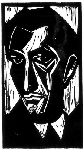
Why can’t I think like Bernard?

20130519-222506.jpg

Sans jury ni récompense

I wish I felt like experimenting with paint.

Aquetin carried out an experiment studying the light passing through the colored panes of glass in his veranda. Bernard wrote and commented on this experiment, ‘Aquetin observed the light streaming through the coloured panes of a glazed door and noticed that yellow produced an impression of sunlight; green of dawn; blue of night; red of twilight.’ Bernard painted ‘The Reaper’ in the key of yellow (often repeated later by Van Gough) and in the key of blue, ‘The Avenue de Clichy at Evening’. These paintings were exhibited at the Revue Independante, at the Salon des Independants and at the headquarters of Les Vingt in Brussells. Read more…

The Société des Artistes Indépendants (Society of Independent Artists), Salon des Indépendants, formed in Paris 19 July 1884. The association began with the organization of massive exhibitions in Paris and was established in response to the rigid traditionalism of the official government-sponsored Salon. Their exhibitions were where new artworks were often first displayed and where paintings were widely discussed and in some cases caused controversial outrage in the newspapers and journals of the polite, conservative Parisian society.

Choosing the tagline “No jury nor awards” (Sans jury ni récompense) the society’s aims were to champion new ideas and thoughts that were prevalent in the cafe cultures of Paris and Europe. These contemporary ideas were being marginalized by mainstream critics and galleries. The strategic alliance between these artists from different backgrounds and methodologies was extremely successful in promoting their collective vision. The publicity gained by this ‘outsider’ tactic became the launching pad for many artists, who by gaining notoriety and publicity, crossed over into the mainstream.

Albert Dubois-Pillet, Odilon Redon, Georges Seurat and Paul Signac were among its co-founders. For three decades their annual exhibitions moulded the art of the early 20th century. World War I brought a closure to the salon, though the Artistes Indépendants remained active.


Notes on Painting – which I should keep reminding myself about :

  1. The act of being creative is a love hate thing – The Beauty and The Beast someone fetch a priest (ref. David Bowie).
  2. Action Painting – Pollock. Print dribbled paint.
  3. Soft pink landscapes (1980) Richard Hamilton A landscape of soft focus and toilet paper – a turgid landscape. Collotype and Screenprint – text and image. A remembered exhibition.
  4. Stoned Moon Series’ was Rauschenberg’s ambitious response to the American space program and the landmark Apollo 11 mission that put Neil Armstrong and Buzz Aldrin on the lunar surface in July 1969.
  5. Being overpowered by a Rothko exhibition.
  6. Being overpowered by a Gerhard Richter exhibition.
Influences

Nazi Propaganda – BOZAR – Francis Bacon’s Studio

There are books that bring new perspectives to painting and the lives / methodologies of artists. Unfortunately Francis Bacon and Nazi Propaganda brings nothing new to the party.

The work and times of Francis Bacon are well documented. The use and origins of Bacon’s source material are well-known, some of which are even preserved. This book is a shortcut, a narrow, tunnel visioned, easy access pass to the imagery that helped to inspire his art – a snapshot and lightweight introduction from a contemporary point of view.

This over emphasis on Nazi imagery is an attempt by the author to shock and imply a tenuous connection between Bacon and the Nazi regime. This book clouds the issue of how artists draw inspiration from the sources around them. These images of Nazi propaganda were (probably) simply metaphors for violence, death and persecution – had Hitler conquered Britain Bacon’s legacy would not exist. They still are powerful photographic and graphic images that send a shudder down your spine but they were only a part of Bacon’s bigger picture.

Does one methodology fit all? – painting is more complicated than that.

It would make more sense to see some of the imagery for yourself. BOZAR fine arts museum in Brussels has an exhibition of Bacon bits. The contents from his studio are part of a show running until May 2013. “Changing States: Contemporary Irish Art & Francis Bacon’s Studio”includes photographs of friends and lovers, medical books, wildlife and sport are jumbled together with classical references and artists monographs as well as unfinished paintings.


The Gilded Gutter Life of Francis Bacon

The paintings of Francis Bacon have always stood out in the crowded museums and galleries that are stuffed full of mediocre British paintings. Daniel Farson gives a personal view of his (if only in his own mind) ‘friend’s’ chaotic debauched life.

In 1962, Farson made a documentary for Associated-Rediffusion about pub entertainment in the East End of London where he lived, called Time Gentlemen Please (this led directly to the company’s later series Stars and Garters, with which Farson was not personally involved). Soon after this he bought a pub, The Waterman’s Arms, in the East End with the explicit intent of reviving old-time music hall, but this failed. By the end of 1964 he had resigned from Associated-Rediffusion (by then renamed Rediffusion London) keeping a lower public profile for the rest of his life. He moved from London to live in his parents’ house in Devon, but continued to visit the pubs and drinking clubs of London’s Soho on a regular basis… Continue reading 

Influences

Vision after the Sermon

La vision après le sermon (Paul Gauguin)

This is one of those paintings I needed to see – it was an important turning point in art history. The bold use of colour was deep rooted and part of the bedrock of the Synthetist style of modern art – an extension of the pioneering vision of other artist including Emile Bernard.

Vision after the Sermon (Jacob Wrestling with the Angel) is an oil painting by French artist Paul Gauguin in 1888. It is now in the National Gallery of Scotland, Edinburgh. It depicts a scene from The Bible, where Jacob wrestles an angel. A vision or hallucination that the Breton women experience after a sermon in church. Painted in Pont-Aven, Brittany, France, the inherent spiritality of subjects in this painting, the influence of the cloisonnist style, all point towards a great painting and a break through in 19 century art.